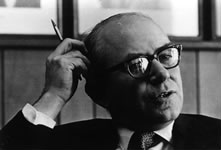
Description
Irving Lowens’ research and writing in American music form a cornerstone for American music history. As the principal founder of the Sonneck Society (now the Society for American Music) and its first president from 1974 to 1981, he was largely responsible for making the study of American music a respective and thriving area in musicology today. During his remarkable career he became distinguished in music criticism, musicology, and music librarianship. In his positions as music critic for the Washington Star (1953–1977), music reference librarian at the Library of Congress (1962–1966), and as Dean at the Peabody Conservatory of Music (1977–1982), he served in turn the public, the scholar, and the music student.
The Irving Lowens Article Award commemorates this remarkable man and his achievements. It is granted annually by the Society for American Music for an article that makes an outstanding contribution to the study of American music, and consists of a plaque and cash award.
Eligibility
Articles eligible for consideration include studies on any aspect of music of the United States, together with investigations of American practices as they inform and intersect with musical cultures and traditions beyond U.S. national boundaries.
The article might have been published in either a peer-reviewed journal or an edited collection. The committee particularly appreciates nominations of articles from collections, because these are harder for us to locate. Authors or nominators of articles in languages other than English must be accompanied by a translation.
We invite nominations for the Society’s Irving Lowens Article Award for an article published in the prior calendar year (as identified by the official copyright date that appears in print on the back of the title page) “that makes an outstanding contribution to American music studies.”
Application Requirements
To submit an article for consideration, click the button below. A PDF of the article is required as part of the application.
Deadline
June 1
Past Winners
| Year | Winners |
|---|---|
| 2026 | Matthew Mendez, "History Beyond Recovery: Julius Eastman and the Challenge of the Heterological" |
| 2025 | Laura Risk, "Ginger Smock: Narratives of Perpetual Discovery, Jazz Historiography, and the 'Swinging Lady of the Violin'" |
| 2024 | Eduardo Herrera, "Latin America and the Decolonization of Classical Music" in Open Access Musicology, Vol. 2 |
| 2023 | Samantha Ege, “‘Chicago, the City We Love to Call Home!’: Intersectionality, Narrativity, and Locale in the Music of Florence Beatrice Price and Theodora Sturkow Ryder,” American Music, Volume 39 (2021) |
| 2022 | Stephanie Doktor, “Finding Florence Mills: The Voice of the Harlem Jazz Queen in the Compositions of William Grant Still and Edmund Thornton Jenkins,” Journal of the Society for American Music, Volume 14 (2020) |
| 2021 | Katie A. Callam, Makiko Kimoto, Misako Ohta and Carol J. Oja, “Marian Anderson’s 1953 Concert Tour of Japan: A Transnational History,” American Music, Volume 37 (2019) |
| 2020 | William Cheng,“Black Noise, White Ears: Resilience, Rap, and the Killing of Jordan Davis,” Current Musicology, Volume 102 (Spring 2018) |
| 2019 | Christopher Wells, “’A Dreadful Bit of Silliness’: Feminine Frivolity and Ella Fitzgerald’s Early Critical Reception” Women and Music: A Journal of Gender and Culture, Volume 21 |
| 2016 | Gayle Magee, “‘She’s a Dear Old Lady’: English Canadian Popular Songs from World War I,” American Music, Volume 34 (2016) |
| 2015 | Michael Iyanaga, “Why Saints Love Samba: A Historical Perspective on Black Agency and the Rearticulation of Catholicism in Bahia, Brazil” Black Music Research Journal, Volume 35 |
| 2014 | Douglas W. Shadle, “How Santa Claus Became a Slave Driver: The Work of Print Culture in a Nineteenth-Century Musical Controversy” Journal of the Society for American Music, Volume 8 |
| 2013 | Scott A. Carter, “Forging a Sound Citizenry: Voice Culture and the Embodiment of the Nation, 1880–1920,” American Music Research Journal, Volume 22 |
| 2012 | Mark Burford, “Sam Cooke as Pop Album Artist–A Reinvention in Three Songs” Journal of the American Musicological Society, Volume 65 |
| 2011 | Karen Ahlquist, “Musical Assimilation and ‘the German Element’ at the Cincinnati Sängerfest, 1879” Musical Quarterly, Volume 94 |
| 2010 | Amy Wlodarski , “The Testimonial Aesthetics of Different Trains”, Journal of the American Musicological Society, Volume 63 |
| 2009 | Cristina Magaldi, “Cosmopolitanism and World Music in Rio de Janeiro at the Turn of the Twentieth Century” Musical Quarterly, Volume 92 |
| 2008 | Brian Harker, “Louis Armstrong, Eccentric Dance, and the Evolution of Jazz on the Eve of Swing,” Journal of the American Musicological Society, Spring, 2008 |
| 2007 | Nancy Yunhwa Rao, “Ruth Crawford’s Imprint on Contemporary Composition” in Ruth Crawford Seeger’s Worlds: Innovation and Tradition in Twentieth-Century American Music, ed. Ray Allen and Ellie Hisama (University of Rochester Press, 2007) |
| 2006 | Leta E. Miller, “Henry Cowell and John Cage: Intersections and Influences, 1933-1941” Journal of the American Musicological Society (Spring 2006) |
| 2005 | Beth Levy, “From Orient to Occident: Aaron Copland and the Sagas of the Prairie,” in Aaron Copland and His World, edited by Carol J. Oja and Judith Tick (Princeton: Princeton University Press, 2005) |
| 2004 | Jairo Moreno, “Bauzá—Gillespie—Latin/Jazz: Difference, Modernity, and the Black Caribbean,” South Atlantic Quarterly Volume 103 (Winter 2004) |
| 2003 | Stanley V. Kleppinger, “On the Influence of Jazz Rhythm in the Music of Aaron Copland,” American Music, Volume 21 (2003) |
| 2002 | J. Peter Burkholder, “The Organist in Ives” Journal of the American Musicological Society (Summer 2002) |
| 2001 | Guthrie Ramsey, Jr., “Who Hears Here? Black Music, Critical Bias, and the Musicological Skin Trade,” Musical Quarterly, Volume 85, No.1 (2001) |
| 2000 | John Graziano, “The Early Life and Career of the ‘Black Patti’: The Odyssey of an African American Singer in the Late Nineteenth Century,” Journal of the American Musicological Society (Fall 2000) |
| 1999 | Brian Harker, “‘Telling a Story’: Louis Armstrong and Coherence in Early Jazz,” Current Musicology, Volume 63 (1999) |
| 1998 | Carol Hess, “John Philip Sousa’s ‘El Capitan’: Political Appropriation and the Spanish-American War,” American Music, Spring 1998 |
| 1997 | Kim H. Kowalke, “For Those We Love: Hindemith, Whitman, and An American Requiem,” Journal of the American Musicological Society |
| 1996 | Mark Tucker, “In Search of Will Vodery,” Black Music Research Journal |
| 1995 | Kim H. Kowalke, “Kurt Weill, Modernism, and Popular Culture: Offentlichkeit als Stil,” Modernism/Modernity |
| 1994 | John Spitzer, “’Oh! Susannah’ : Oral Transmission and Tune Transformation,” Journal of the American Musicological Society |
| 1993 | Judith Tick, “Charles Ives and Gender Ideology,” Music and Difference |
| 1992 | Robert Walser, “Eruptions: Heavy Metal Appropriations of Classical Virtuosity,” Popular Music |
| 1991 | Scott DeVeaux, “Constructing the Jazz Tradition: Jazz Historiography,” Black American Literature Forum |