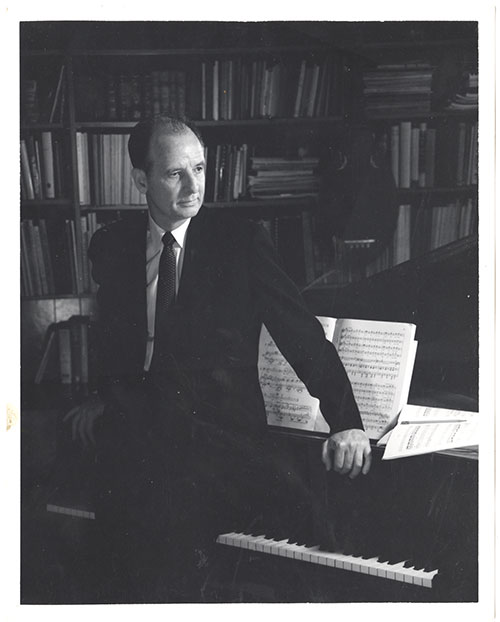
Description
The Wiley Housewright Dissertation Award is designed to recognize a single dissertation on American music for its exceptional depth, clarity, significance, and overall contribution to the field. American music is interpreted in all its historical and contemporary styles and contexts, including, but not limited to art and popular musics, the musics of ethnic groups and minorities, and the full range of activities associated with music. “America” is understood here to embrace North America (Canada, The United States, and Mexico), including Central America and the Caribbean, and aspects of its cultures elsewhere in the world.
The Award carries with it a monetary prize as well as a citation that will be presented at the national conference each spring.
Eligibility
The dissertation must be in English, and must be for a degree awarded in calendar year 2025. Authors who entered the competition in a previous year may not enter again.
DMA and other terminal degree documents will be considered as long as the entire piece of scholarship is included in a written document (i.e., musical compositions or other materials will not be considered).
Application Requirements
In addition to the application form, the following materials are required in PDF format, naming the files as indicated starting with your last name:
- The title page and abstract of your dissertation (YOURLASTNAME_Abstract.pdf)
- The table of contents (YOURLASTNAME_TableofContents.pdf)
- Preface or Introduction (YOURLASTNAME_Introduction.pdf)
- One sample chapter (YOURLASTNAME_Chapter.pdf)
Note: If any of your files is larger than 15MB, please send the file using www.hightail.com and notify the Housewright committee chair. Any deviation from these instructions will complicate the committee’s decision process.
Please do not mail the complete dissertation at this time.
Deadline
June 1
Past Winners
| Year | Winners |
|---|---|
| 2026 | Jade Conlee, "Empire's Sonic Atmospheres: Background Music and Racial Worldmaking" (Yale University) |
| Honorable Mention: Chase Castle, "The Gospel in Black and White: Race and Power in American Evangelical Hymnody, 1840-1900" (University of Pennsylvania) | |
| 2025 | Michael M. Kennedy, "(Re)Orchestrating the Musical: Postmodernism and the Electro-Acoustic Sound of Contemporary Broadway" (University of Cincinnati, College-Conservatory of Music) |
| 2024 | Samantha Cooper, "Cultivating High Society: American Jews Engaging European Opera in New York, 1880-1940" (New York University) |
| 2023 | Maria Ryan “Hearing Power, Sounding Freedom: Black Practices of Listening, Ear-training, and Music-making in the British Colonial Caribbean” (University of Pennsylvania) |
| 2022 | Katie Callam, "To Look After and Preserve: Curating the American Musical Past, 1905-1945" (Harvard University) |
| 2021 | Lucy Caplan, "High Culture on the Lower Frequencies: African Americans and Opera, 1900-1933" (Yale University) |
| Honorable Mention: Nadia Chana, “To Listen on Indigenous Land: Method, Context, Crisis” (University of Chicago) | |
| 2020 | Daniel Fernando Castro Pantoja, “Antagonism, Europhilia, and Identity: Guillermo Uribe Holguín and the Politics of National Music in Early Twentieth-Century Colombia” (University of California, Riverside). |
| 2017 | Kirsten L. Speyer Carithers, “The Work of Indeterminacy: Interpretive Labor in Experimental Music” (Northwestern University) |
| 2016 | Frederick J. Schenker, “Empire of Syncopation: Music, Race, and Labor in Colonial Asia’s Jazz Age” (University of Wisconsin, Madison) |
| 2015 | Darren Mueller, “At the Vanguard of Vinyl: A Cultural History of the Long-Playing Record in Jazz” (Duke University) |
| Honorable mention: Jesse P. Karlsberg, “Folklore’s Filter: Race, Place, and Sacred Harp Singing” (Emory University) | |
| 2014 | Christopher J. Wells, “ ‘Go Harlem’! Chick Webb and his Dancing Audience during the Great Depression” (University of North Carolina) |
| 2013 | R. Daniel Blim, “Patchwork Nation: Collage, Music and American Identity” (University of Michigan) |
| 2012 | Glenda Goodman, “American Identities in an Atlantic Musical World: Transhistorical Case Studies” (Harvard University) |
| 2011 | Sheryl Kaskowitz, “As We Raise Our Voices: A Social History and Ethnography of ‘God Bless America,’ 1918–2010” (Harvard University) |
| 2010 | Nathan Platte, “Musical Collaboration in the Films of David O. Selznick, 1932–1957” (University of Michigan) |
| 2009 | Katherine Leigh Axtell, “Maiden Voyage: The Genesis and Reception of Show Boat, 1926–1932” (University of Rochester) |
| 2008 | Jonathan Greenberg, “Singing Up Close: Voice, Language, and Race in American Popular Music, 1925–1935” (UCLA) |
| 2007 | Ayden Adler, “Classical Music for People Who Hate Classical Music”: Arthur Fiedler and the Boston Pops, 1930–1950 (Eastman School of Music) |
| 2006 | Drew Davies, “The Italianized Frontier: Music at Durango Cathedral, Espanol Culture, and Aesthetics of Devotion in Eighteenth-Century New Spain” (University of Chicago) |
| 2005 | Jeremy Grimshaw, “Music of a ‘More Exalted Sphere’: Compositional Practice, Biography, and Cosmology in the Music of La Monte Young” (Eastman School of Music) |
| 2004 | Charles Hiroshi Garrett, “Struggling to Define a Nation: American Music in the Twentieth Century” (UCLA) |
| 2003 | Mark J. Butler, “Unlocking the Groove: Rhythm, Meter, and Musical Design in Electronic Dance Music” (Indiana University) |
| 2002 | Mark Clague, “Chicago Counterpoint: The Auditorium” (University of Chicago) |
| 2001 | Elyse Carter Vosen, “Seventh-Fire Children: Gender, Embodiment, and Musical Performances of Decolonization by Anishinaabe Youth” (University of Pennsylvania) |
| 2000 | Sandra J. Graham, “The Fisk Jubilee Singers and the Concert Spiritual: the Beginnings of an American Tradition” (New York University) |
| 1999 | Amy C. Beal, “Patronage and Reception History of American Experimental Music in West Germany, 1945–1986” (University of Michigan) |
| 1998 | David Ake, “Being Jazz: Identities and Images” (UCLA) |
| 1997 | Jennifer L. DeLapp, “Copland in the Fifties: Music and Ideology in the McCarthy Era” (University of Michigan) |
| 1996 | David Patterson, “Appraising the Catchwords, c. 1942–1959: John Cage’s Asian- Derived Rhetoric and the Historic Reference of Black Mountain College” (Columbia University) |